Payment terms tell a client when an invoice is due. Net 15 means due 15 days after the invoice date. Net 30 means 30 days. The choice changes when cash reaches you, so pick it on purpose and not by habit.
Quick answer
Use Net 15 for small jobs, new clients and work you already delivered in full. Use Net 30 when a client’s finance team requires it and the project is large enough to justify the wait. If you must offer Net 30, ask for a deposit or split the invoice into milestones.
What the two terms mean in dates
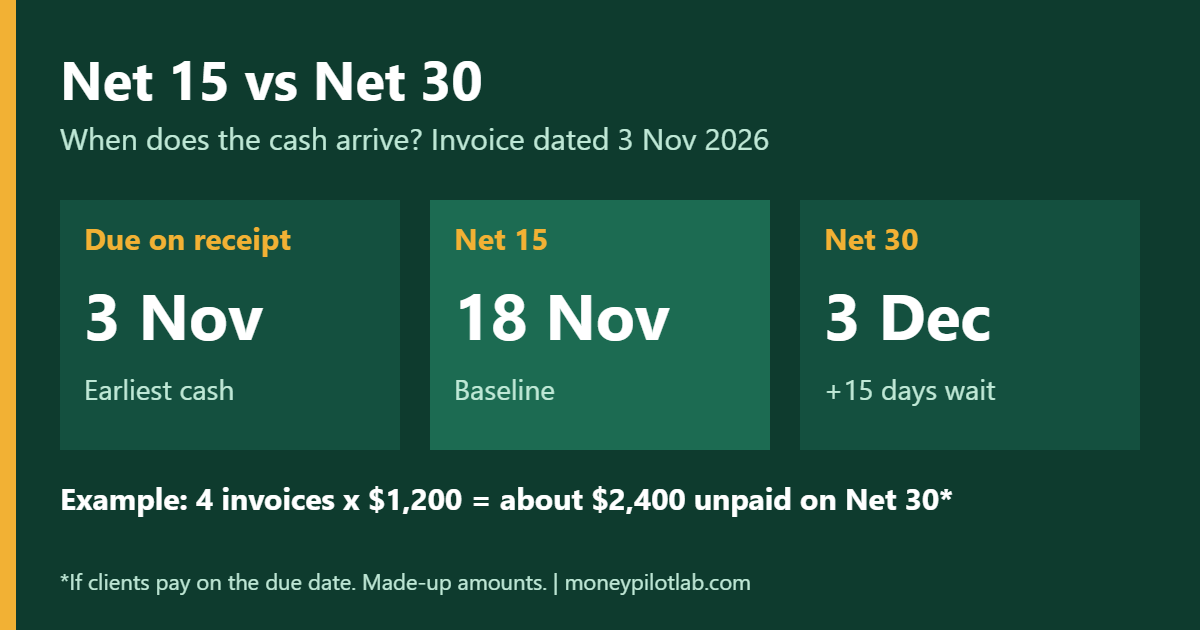
The clock starts on the invoice date. Here is an example for an invoice dated 3 November 2026.
| Term | Days to pay | Due date | Extra wait vs Net 15 |
|---|---|---|---|
| Due on receipt | 0 | 3 Nov 2026 | Earlier by 15 days |
| Net 15 | 15 | 18 Nov 2026 | Baseline |
| Net 30 | 30 | 3 Dec 2026 | 15 more days |
This assumes the client pays on the due date. Many clients pay late, so the real gap can be longer.
A simple cash flow example
Say you send four invoices a month, each for $1,200. That is $4,800 a month. With Net 30, each payment arrives about 15 days later than it would under Net 15, if clients pay on time. In plain terms, about half a month of billing, or roughly $2,400, sits unpaid at any moment. Under Net 15 the same amount of billing is unpaid for a shorter time. Use your own numbers in this formula: invoices per month times invoice value times extra days divided by 30.
How to choose
| Question | If yes | If no |
|---|---|---|
| Is the client new to you? | Net 15, or a deposit first | Either term can work |
| Is the invoice small? | Net 15 or due on receipt | Consider milestones |
| Does the client’s finance team require Net 30? | Accept Net 30 with a deposit | Offer Net 15 |
| Did this client pay late before? | Shorter terms and reminders | Keep your usual terms |
| Is the work finished and delivered? | Net 15 is easy to defend | Bill by milestone |
Put the terms in writing
- State the term in your proposal or contract, not only on the invoice.
- Show the invoice date and the exact due date on every invoice.
- Set the default payment term in your invoicing tool, so each invoice carries it.
- If you want a late fee, state it in the agreement before you send the first invoice. Rules on late fees differ by place, so check your local rules.
- Plan one friendly reminder a few days before the due date and one the day after.
When to say no to longer terms
If a client asks for Net 60 or longer, think about the cost. Ask for a deposit, shorter milestones, or a small discount for early payment. If none of that works, decide whether the project is worth the cash gap.
Your next step
Pick one term for your next three new clients. Write it in the proposal. Add the exact due date to the invoice and set a reminder for the day after.
This is general business guidance, not legal or tax advice. The examples use made-up amounts. This page has no affiliate links.